
In our day-to-day work with clients, we have noticed over the past few months a shift in tone in conversations about AI agents: the question is no longer "which use case should we try", but "how do we prove it is working", and it is a change that the data clearly confirm. According to an IDC survey (C-Suite Survey, September 2025), 62% of Italian executives consider the implementation of artificial intelligence solutions their top technology priority for the next twelve months, and the same research points out that investment priorities for 2026 focus on two precise goals: strengthening AI governance and improving the ability to measure and communicate the value generated by projects.
For us at Moku, as we support companies in designing management systems and applied artificial intelligence solutions, this shift marks the end of one phase and the beginning of another, more demanding and, all things considered, more interesting.
From experimentation to scale: why 2026 changes the rules of the game
In the first phase of AI adoption in business, the dominant question was almost always the same: where can we try it. A well-chosen pilot project was enough, often a first AI agent on a narrowly defined process, and the result was already considered a success regardless of its measurable impact on the income statement.
This logic, understandable in an exploratory phase, no longer holds once AI agents stop being an isolated experiment and become a structural part of business processes. It is what a Celonis executive recently described in Forbes Italia as the move into the "second half" of AI: after an initial phase dominated by enthusiasm and experimentation, the current challenge is turning the technology's potential into concrete, measurable and scalable value.
The same IDC research cited above shows how far this transition is already under way across Italy's business landscape: companies are moving from experimental use of AI to implementations at scale, with far more tangible goals such as higher productivity, lower decision-making costs and more personalized offerings. In this scenario, the ability to transparently quantify return on investment (ROI) becomes the real dividing line between those who keep experimenting and those who turn AI agents into a structural competitive advantage.

What AI agent governance is, and why it cannot be a last-minute afterthought
Talking about AI agent governance means defining, before a project is even launched, who decides, who oversees and who is accountable for the results. A solid governance framework typically rests on a few pillars that are worth keeping distinct when designing a new use case:
clear guidelines for how models are used;
a level of human oversight proportionate to the risk of the automated process;
a system for identifying and mitigating bias or hallucinations before they reach a customer or a business decision;
ongoing oversight of regulatory compliance, which in the European context means keeping track of the evolution of the AI Act and its simplification mechanisms, a topic we explored in our dedicated article.
One aspect that, in our experience, is still underestimated is that governance is not a layer of control added on top of a project already under way, but the condition that makes it scalable. An AI agent that works within a small experimental scope can prove risky, or simply unreliable, once it is extended to an entire department without anyone having defined in advance who is responsible for it and by which criteria its quality is measured over time.
It is one of the areas in which we most often support our clients through our applied AI consulting: not just building the agent, but building the structure of accountability that allows it to grow without surprises.
Measuring the ROI of AI agents: the metrics that really matter
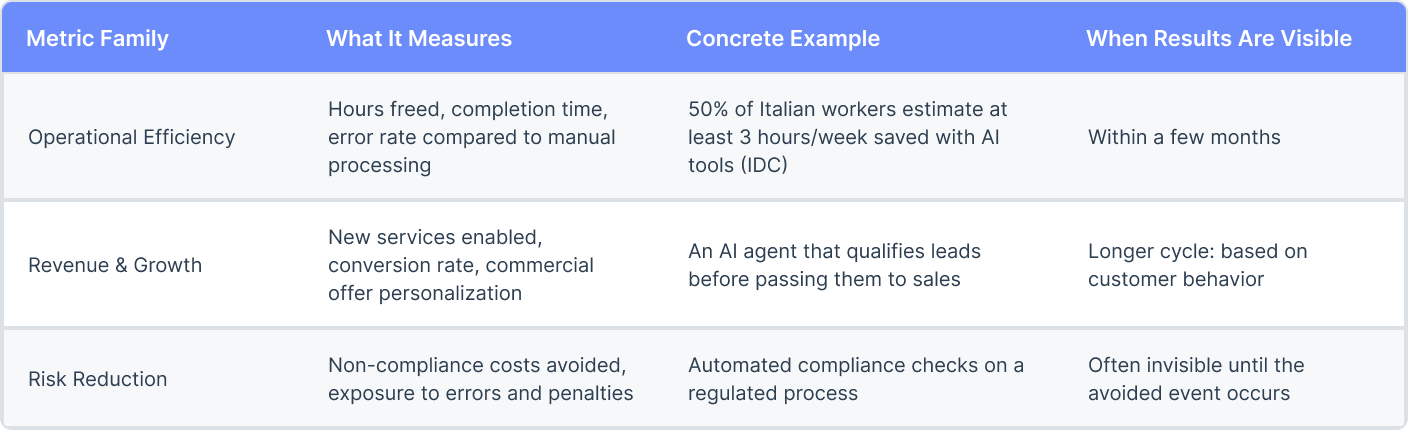
When an artificial intelligence project is judged only on the initial enthusiasm of the team that proposed it, the risk is that its real effectiveness remains suspended in a gray area that is hard to defend in front of management. To avoid this, it is worth distinguishing at least three families of metrics, to be defined before the project starts, not after:
A common mistake when building a generative AI agent on company data is to focus solely on the quality of the model and overlook the reliability of the knowledge base it draws on, a topic we covered in our article RAG: how to make AI trustworthy in the workplace and one that remains a silent prerequisite for any ROI measurement: a model fed with incomplete or misaligned data produces results that, however convincing in form, struggle to hold up against rigorous business metrics.
From isolated measurement to a sustainable framework
Measuring a single project is relatively simple: the real leap in quality, the one the IDC surveys describe as a 2026 priority for Italian companies, lies in building a repeatable measurement framework that can be applied to every new AI agent before it is even developed.
In our experience, this means first of all assigning clear ownership to every initiative, so that it is not left without anyone accountable once the initial enthusiasm has faded, and secondly integrating AI metrics into the same management systems the company already uses for management control, rather than treating them as a parallel dashboard disconnected from the rest of the business.
This second point is crucial: an AI agent that generates valuable data but does not communicate with the ERP or with existing reporting tools ends up producing two versions of the company's truth, one of which is bound to be ignored at the first budget review. When measuring, it is also worth distinguishing between automation and genuine decision-making autonomy, a difference we explored in Intelligent Workflow: AI agents or just automation?, because the two categories of project require different KPIs and levels of oversight.
Why now: the link with business resilience
There is one last element of context worth recalling, because it helps explain why the governance and ROI of AI agents have become such urgent issues at this very moment. The same IDC research reports that 64% of Italian companies expect an economic recession within the next twelve months, and yet 70% of these businesses have nonetheless increased their IT investments, directing them in particular towards artificial intelligence, automation and the strengthening of back-office systems.
In a climate of economic uncertainty, investing in AI agents without solid governance and clear value metrics means increasing exposure to risk precisely when companies most need stability and predictability. Conversely, a well-built measurement framework turns artificial intelligence from a discretionary cost into a lever for business resilience, capable of generating verifiable results even when the macroeconomic context remains uncertain.
For Italian companies, 2026 is therefore shaping up to be the year in which AI agents stop being assessed for their potential and start being judged on their results. Organizations that manage to build a governance and value-measurement framework now will gain an advantage that goes beyond any single technology implementation: the ability to choose, with data in hand, where to keep investing and where to stop.

Frequently asked questions about AI agent governance and ROI
How long does it take to see a measurable return from an AI agent?
It depends on the family of metrics chosen: operational efficiency gains on a well-defined process often become visible within a few months, whereas the impact on revenue and growth generally requires a longer cycle, because it runs through customer behavior and not just internal optimization. It is worth defining a realistic measurement horizon for each metric from the outset, rather than expecting a uniform result on every front.
Who should be responsible for AI agent governance: IT or the business?
Neither of the two is enough on its own, because IT brings technical expertise on risk, security and data quality, while the business brings knowledge of the processes and of the metrics that really matter for that specific department. Effective governance comes from the meeting of the two perspectives, not from delegating exclusively to one of them.
How do you measure ROI when an AI agent does not produce direct savings in euros?
In the case of generative AI, value is often qualitative, for example in the ability to respond to customers or in the quality of a piece of content. In these cases, metrics such as first-response time, the escalation rate to a human operator or the reduction in errors corrected during review provide solid evidence of value, provided they are tracked with the same discipline reserved for a project with a direct economic impact.
Is a governance framework needed even for a small-scale pilot?
Yes, because the foundations of governance — clear accountability, metrics defined in advance, oversight proportionate to risk — should be laid from the very first pilot: it is far more costly to build them later on a project already extended across several departments than to plan for them from the start, even on a reduced scale.